

 Call us Today


Why Weighing Terminology Matters
Weighing scales and balances are fundamental to operations across countless workplaces where even small inaccuracies can lead to significant financial and regulatory consequences. They are the lifeblood of industries such as food processing, manufacturing, transportation, mining, and agriculture. Despite their importance, buyers and end users often encounter confusion when faced with technical weighing terminology, making it difficult to accurately compare systems, assess performance claims, or select equipment that truly meets operational requirements.
A clear understanding of weighing terms is essential for ensuring measurement accuracy, maintaining compliance with industry standards and legal-for-trade regulations, and optimizing cost efficiency over the life of the system. Misinterpreting specifications or performance metrics can result in overpaying for unnecessary features, underestimating system limitations, or risking non-compliance and costly rework.
This guide breaks down the core terminology used in weighing systems, providing clarity where confusion is common. By understanding these key terms, you’ll be better equipped to evaluate options confidently, choose the right equipment for your application, and make informed decisions that protect both operational integrity and long-term costs.
Readability: The Smallest Weight Increment
Readability refers to the smallest measurable increment, or minimum weight change, that an analytical balance is capable of displaying. In simple terms, it defines the finest level of detail the balance can show in a weighing result. Readability is often expressed as the value of the last digit displayed on the balance, such as 0.1 g, 0.01 g, or 0.001 g.
It is important to note that readability should not be confused with accuracy. While readability determines how many decimal places are shown, it does not guarantee that the displayed value is correct. A balance may display very small increments, but factors such as calibration, environmental conditions, and instrument quality ultimately determine how accurate and repeatable those measurements are.
Understanding readability is essential because it directly affects whether a balance is suitable for a specific application. Selecting a balance with insufficient readability may prevent users from detecting small but meaningful weight changes, leading to measurement uncertainty or compromised results. Conversely, choosing a balance with excessively fine readability for a routine application can increase cost, sensitivity to environmental disturbances, and operational complexity without adding practical value.
As an example, a balance with a readability of 0.001 g can display weight changes in increments of one milligram. This level of readability is often required for laboratory, pharmaceutical, or research applications where precise mass determination is critical. By matching readability to the actual requirements of the task, users can ensure reliable measurements, regulatory compliance, and efficient use of resources.
Repeatability & Reproducibility
Repeatability describes the ability of a measurement system or experimental procedure to deliver consistent results when the same test is performed multiple times under identical conditions. These conditions typically include the same operator, the same instrument, the same location, and measurements taken over a short time interval. When all controllable variables remain constant, repeatability reflects the inherent precision of the measurement process.
In practice, repeatability quantifies how closely individual results agree with one another when a measurement is repeated. For example, if a researcher performs the same test several times in succession using the same methodology and obtains nearly identical results each time, the measurement system demonstrates strong repeatability. This consistency builds confidence that the observed results are not due to random variation, operator error, or instrument instability.
Repeatability is critically important because it forms the first and most essential step toward reproducibility. Reproducibility requires that results can be reliably obtained again under changed conditions, e.g. different operators, different instruments, different locations, different periods.
Importantly, reproducibility cannot exist without repeatability. If a measurement cannot produce consistent results under tightly controlled conditions, it cannot be expected to remain consistent when conditions vary. In this way, repeatability serves as the foundation upon which reproducibility is established.
Beyond research environments, repeatability plays a vital role in industrial, clinical, and regulatory settings. Manufacturing operations depend on repeatable measurements to maintain product quality and process control. Clinical and analytical laboratories rely on repeatability to ensure test results are dependable before they can be validated across different technicians or facilities. Regulatory compliance also hinges on repeatable measurement performance, as it demonstrates that a system is stable, controlled, and suitable for its intended use.
Linearity: Accuracy Across the Weighing Range
Linearity refers to the ability of a scale or balance to provide accurate results consistently across its entire weighing range, from very small loads to its maximum capacity. It ensures that the instrument remains reliable at all weight levels, rather than being accurate at only a single point. This is especially important in applications where measurements vary widely and consistent performance is required.
Linearity is typically assessed by applying certified test weights at multiple points across the weighing range and comparing the displayed values to the known reference weights. When plotted on a graph, ideal results form a straight line. In real instruments, small deviations are expected, so acceptable performance is defined by a permissible tolerance band above and below the ideal line. As long as results remain within this range—even if they follow a slight S-shaped curve—the scale or balance is considered linear for its intended use.
Linearity matters because measurement errors can change at different points in the weighing range. For example, a laboratory balance may be used to weigh a small amount of powder and later a much heavier sample. Poor linearity could cause the error at higher weights to differ significantly from the error at lower weights, leading to inconsistent or misleading results.
Similarly, in industrial or shipping applications, a scale must deliver the same level of accuracy whether it is weighing a light envelope or a package near full capacity. Good linearity ensures predictable accuracy and controlled margins of error across the full weighing range, supporting reliable measurements, compliance, and confidence in results.
Minimum Weight: The Smallest Reliable Load
Minimum weight is the smallest sample mass that can be weighed while still achieving an acceptable level of measurement uncertainty for a given balance. It takes into account the potential error of the weighing system, ensuring that the result remains reliable and fit for use.
When the sample quantity is too small, measurement uncertainty represents a disproportionately large share of the measured value. As a result, the weighing result may appear precise but is statistically unreliable and unsuitable for accurate analysis. This risk is particularly critical in regulated or quality-sensitive applications.
For this reason, when a balance has a defined minimum weight, operators must ensure that the net sample weight—excluding the tare—does not fall below this threshold. Adhering to the minimum weight requirement helps maintain data integrity, supports compliance, and ensures that weighing results can be trusted for decision-making and reporting.
In sectors such as the pharmaceutical industry, minimum weight is closely linked to a balance’s repeatability and readability, ensuring that measurements are both reliable and meaningful. Repeatability measures how consistent a balance is when weighing the same sample multiple times, while readability determines the smallest increment the balance can display. Both factors influence the smallest sample that can be weighed accurately—the minimum weight.
Standards like the United States Pharmacopeia (USP) General Chapters <41> and <1251> guide on this. They define minimum weight based on repeatability: if a sample is too small, random variations in repeated measurements (the standard deviation) can make the results unreliable. According to USP <41>, the minimum weight should be large enough that twice the standard deviation divided by the sample weight does not exceed 0.10%.
In simpler terms, the minimum weight ensures that the sample is big enough relative to the balance’s precision and sensitivity. This prevents errors from dominating the measurement and guarantees that readings are accurate, repeatable, and meaningful, whether you are weighing milligrams of a drug or larger quantities.

Maximum Capacity
The maximum capacity of a scale is the heaviest load it can accurately measure. Think of a scale like a 12-inch ruler: the ruler can only measure objects up to 12 inches long, and anything longer falls outside its range. Similarly, a scale with a 30kg capacity can only weigh items up to 30kg.
When selecting a scale, it’s important to choose one with a maximum capacity that exceeds the weight of the heaviest item you plan to weigh, while also taking into account the scale’s division value (see Scale Division, “d”). Unlike a ruler, placing a load that exceeds a scale’s capacity can damage the instrument permanently, so always ensure the scale is rated for the heaviest expected load (see Overload Capacity).
Understanding the ‘e’ Value: Verification Scale Interval
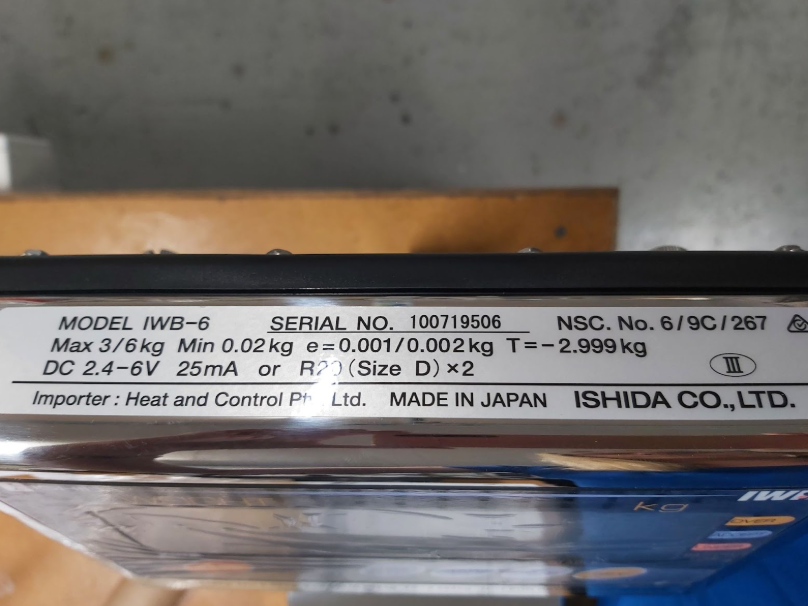
The “e” value on a scale represents the verification scale interval, or `maximum permissible error’, which is the smallest increment of weight that can legally be used to calculate price in commercial transactions. Essentially, it defines the scale’s certified accuracy for trade purposes and ensures that measurements are legally reliable when used for selling goods by weight. The “e” value varies by scale model and is determined by the manufacturer when the device is submitted for type approval under the relevant regulatory system, such as NTEP in the US, CE in Europe, NRCS in South Africa, OIML internationally, and NMI in Australia.
NMI Number: Trade Approval Identification
In Australia, any business selling goods by weight or measure must use a verified, trade-approved weighing scale. While some scales come with a trade certificate at purchase, not all scales are eligible for trade certification, so it’s important to confirm the scale’s approval status before use.
The National Measurement Institute (NMI) grants trade approval to scales that meet their strict regulatory requirements. Once a scale passes inspection, it receives a pattern approval and an NMI Approval number. Scales with this approval can then be tested and verified by accredited personnel, ensuring they are legally compliant for trade use.
Businesses that sell goods by weight or volume, or that manufacture, pack, import, or sell pre-packaged products, must comply with Australian trade measurement laws. This also applies to companies that supply, service, or maintain weighing equipment. The rules cover both wholesale and retail operations.
While some might be tempted to eschew these rules, our professional and personal advice is that these rules should be followed, as non-compliance carries serious penalties. Companies can be fined up to $170,000 per offence, while individuals face fines up to $34,000. Using approved scales is not just a regulatory requirement; it protects your business and ensures fairness for your customers.
Weighing Classes Explained: Class I, II, & III
Legislation defines several accuracy classes for scales, based on the verification scale interval (e)—the smallest unit of weight the scale can reliably measure.
These classes help determine which scale is suitable for different applications, and are important because they ensure that the scale’s accuracy is appropriate for its application, whether for laboratory research, commercial trade, or general weighing tasks.
- Class I: Special: Extremely precise scales designed for laboratories or other applications requiring high accuracy. The verification scale interval is at least 0.001 g.
- Class II: High: Slightly less precise than Class I but still suitable for tasks that demand high accuracy.
- Class III: Medium: Commonly used in commercial settings, such as shops or supermarkets. Accuracy is lower than Class II but sufficient for everyday commercial use.
- Class IIII: Ordinary: Used for rough measurements where high precision is not necessary. The verification scale interval is at least 5 g.
Weighing Terminology Table
| Term | What it Means | Why it Matters | Example |
| Readability (d) | Smallest weight increment shown | Determines measurement detail | 0.001 g = 1 mg steps |
| Repeatability | Consistency of repeated measurements | Ensures reliable results | 50 g sample weighs the same 10 times |
| Linearity | Accuracy across the full range | Reliable results for light & heavy items | 1 g and 1000 g are both accurate |
| Minimum Weight | The smallest sample weighed accurately | Avoids high relative error | 0.01 g minimum → don’t weigh 0.001 g |
| Maximum Capacity | Heaviest weight allowed | Prevents overload & damage | 30kg scale → can’t weigh 40kg |
| Verification Interval (e) | Smallest unit for legal trade | Ensures compliance & fairness | 0.01 g used to price powders |
| Accuracy Class | Scale precision rating | Guides correct use | Class I = lab, Class III = shop |
Advanced Terminology in Weighing Technology
Load Cells
Load cells are the central component in modern weighing systems. They measure the force of the weight and convert it into an electrical signal that the scale can display. Different types, such as strain gauge and hydraulic, are designed for specific applications. Regular care and maintenance help keep load cells accurate and extend their lifespan.
Calibration
Calibration is the process of adjusting a scale to ensure its readings are correct. Regular calibration—done internally or by a certified professional—is essential to maintain measurement accuracy, comply with legal standards, and protect business operations where precise weights are critical.
Hysteresis
Hysteresis is the small difference in readings when weighing the same item multiple times under different conditions. Minimising hysteresis is important for high-precision tasks, like in manufacturing or aviation, where even minor inconsistencies can affect quality or safety.
Drift
Drift happens when a scale’s readings gradually change over time without any change in the weight being measured. It’s often caused by factors like temperature or humidity. Controlling drift is vital to ensure scales remain accurate for long-term or continuous use.
Conclusion
Understanding weighing terminology is essential for selecting the right scale, ensuring accurate measurements, and meeting legal and regulatory requirements. Always consider your application, compliance needs, and operating environment. You can explore our wide range of fine weighing equipment here. If you have any doubts, queries or concerns about what scales you need, it’s always a good idea to consult a weighing specialist.
Have questions about our products and services?
We are here to help. Please fill in our online enquiry form below, and we will respond to you within the next business day.